Parametrized Assets Generator
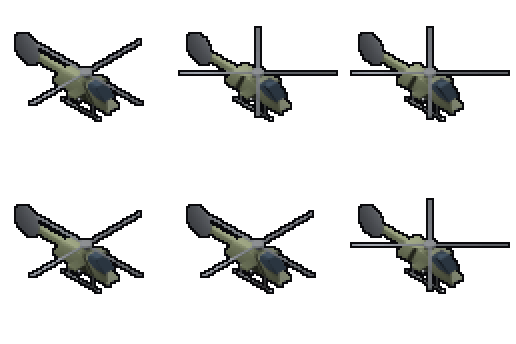
One of the common problems I have is working with empty assets during the early stages of game development. When prototyping, devs usually rely on existing assets from online resources, asset stores or primitive objects provided by their game engine of choice. While this approach works, I often find the experience inconsistent and daunting. More importantly, they don’t provide full control over the visual direction of the game, which can become surprisingly demotivating. Even when everything works functionally, the project doesn’t feel like it is your game.
Following up on my previous blog post about Procedural Generation in Video Games, I started exploring an alternative approach. Instead of relying on existing assets, why not generate “good enough” assets that can be tweaked and refined into the style that I want?
The idea fits my current use case perfectly. The prototype game in video games that I have in mind does not need production-quality art. A pixel-art style is more than enough. As I researched further, I realized I could leverage Blender alongside a Large Language Model (LLM) to help me in this process. By using an LLM to draft Python scripts, I can generate simple parameterized 3D objects inside Blender. These objects can then be rendered from 8 different directions at a low resolution, creating a pixel-art style through downsampling. Now, the entire process, from model generation to sprite asset, can be somewhat automated.
Not only does this save a significant amount of time, but the parameterized nature of the assets also gives me the flexibility. I can tweak values manually or add new features programmatically at any time. For example, if I want a vehicle to have additional turrets or structural variations, I can simply modify the generation parameters rather than creating a new asset from scratch.
Of course, this approach has limitations. Creating highly detailed models is difficult with a procedural system like this. However, that tradeoff is perfectly acceptable for my goals. The pixel-art style naturally hides many imperfections, and that aesthetic aligns with what I am looking for anyway. As someone who enjoys the technical side of game development more than asset creation, this workflow feels like a natural fit.
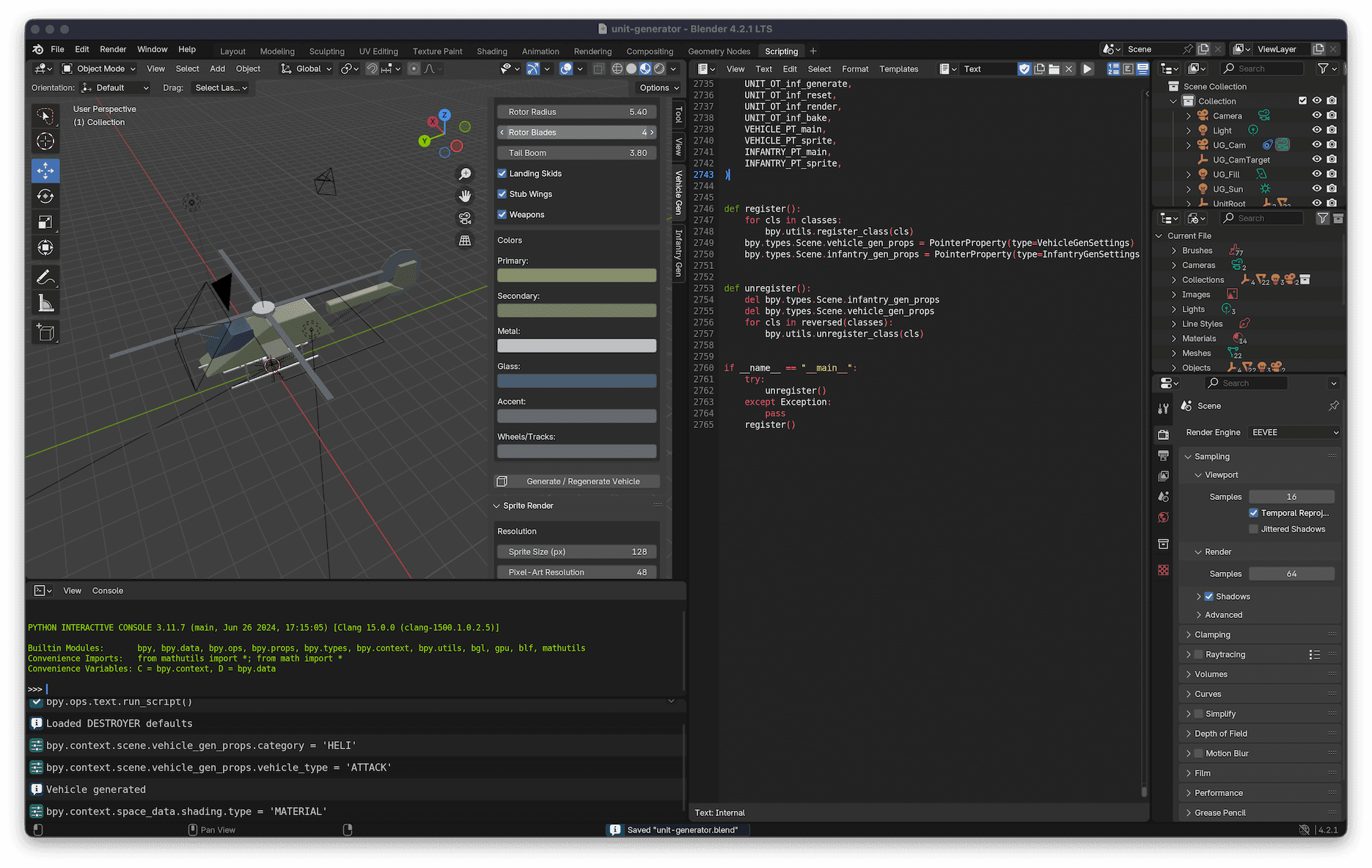 A screenshot of the blender asset generator setup
Another advantage is animation generation. Since the source asset is a 3D model, I only need to animate once. From there, I can automatically render and export sprites for every viewing angle. Compared to drawing every frame manually, this dramatically reduces both time and effort so that I can focus more on the gameplay.
Here is the result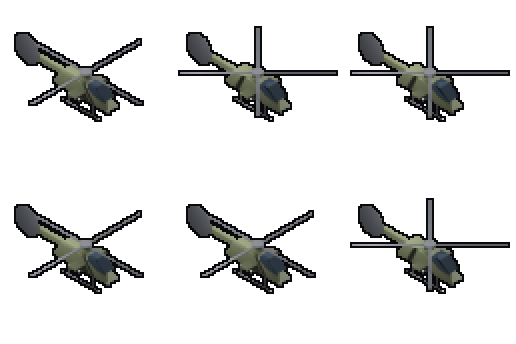 Animated helicopter rendered at 44 deg as a GIF
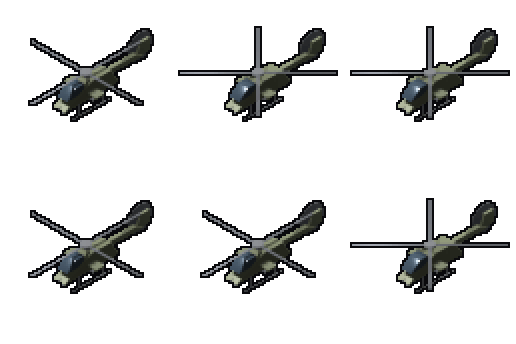 Animated helicopter rendered at 308 deg as a GIF
Why am I doing this?
Well, building a fully 3D game introduces an additional layer of complexity (one dimension higher!). However, I still want to capture the visual feel and depth of a 3D game while retaining the simplicity and efficiency of a 2D game. Games such as Factorio and Red Alert 2 show how effective this approach can be. In short, you get many visual benefits of 3D while maintaining the performance advantages of sprite-based 2D games.
This also opens up interesting possibilities for developing more ambitious projects while keeping computational requirements relatively low. At this stage, I do not have a full game in mind. But I am primarily experimenting and refining my personal game development pipeline.
Furthermore, what excites me as well is the idea that we can use LLMs as a programming tool rather than an asset generator. The model helps me write code that generates assets according to rules and parameters that I control. The final visual output remains consistent, customizable and aligns with the artistic direction I want.
There are already AI tools that can generate 2D or 3D assets directly, but I generally find their outputs inconsistent and difficult to integrate into a cohesive visual style. More importantly, I am not a big fan of relying on AI-generated artwork. In my opinion, art should be created by people. While AI can be an excellent tool for assisting with technical workflows, I believe human creativity and artistic expression remain essential, especially within indie game development. Rather than replacing artists, I prefer using AI to automate technical tasks, allowing developers to build tools that support their creative vision.