Procedural Generation in Video Game Development
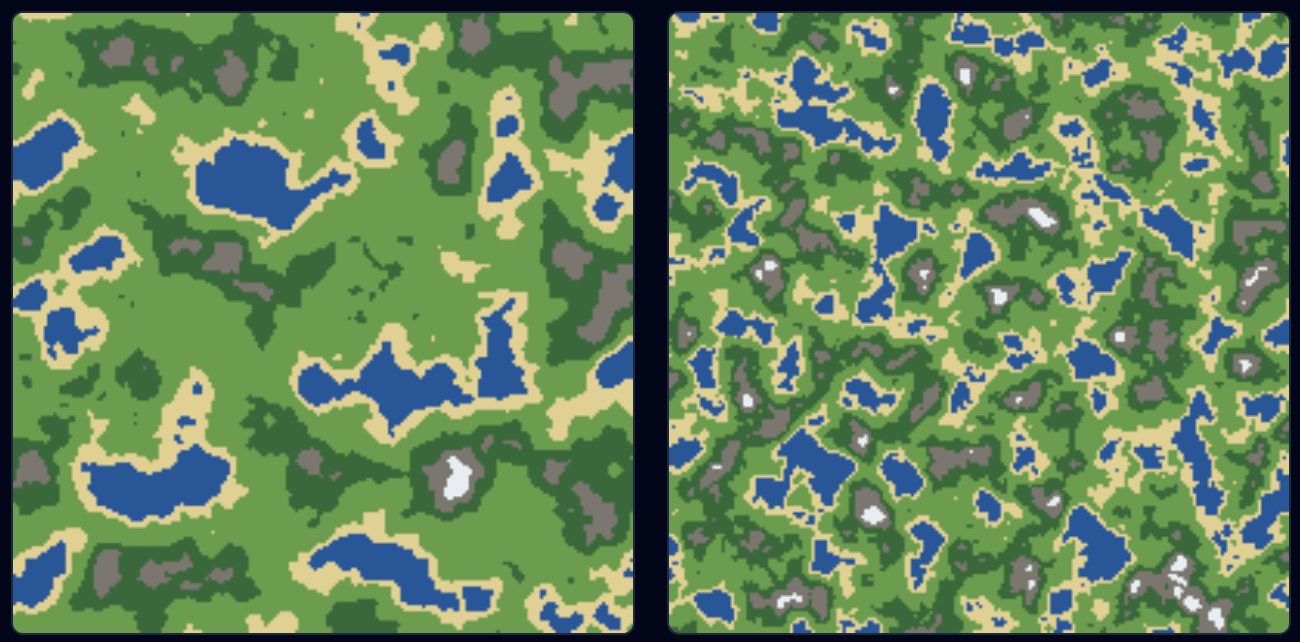
An interesting idea I came across while exploring game development is procedural generation, a way to generate objects through mathematical functions rather than by hand. Procedural generation offers an alternative where it builds the map through code that follows certain patterns.
For example, when building a game terrain, a game designer could model a landscape by sculpting in 3D software, but that can be very time-consuming and may not suit a particular game genre. Another approach is to use procedural generation, where we utilize a “noise” function. A noise function is a mathematical function where we take in a coordinate (x, y) as an input and the function returns a floating-point value in the range [0.0, 1.0], which you can imagine as a grayscale value where 0.0 is black and 1.0 is white. We can then map intervals of that range to different tile types, for example, water is below 0.3, sand is from 0.3 to 0.4, and grass is above 0.4 and so on.
Different noise functions produce different patterns, and some may suit a given particular art style or genre better than others. For terrain, Perlin noise and Simplex noise are the most common choices.
Perlin Noise - https://en.wikipedia.org/wiki/Perlin_noise
Simplex Noise - https://en.wikipedia.org/wiki/Simplex_noise
To see the difference between Perlin and Simplex noise. You have to look at the distribution graph or set the scale to 10 and octaves to 1.
Furthermore, procedural generation can be more helpful than just terrain generation. In the “Project Tomorrow” video, Youtuber, advancenine discusses the idea that, rather than committing to a fixed game design and gameplay up front, it is often better to build a system. This system allows the game to evolve over time using procedural generation to save effort and expand more interesting designs. For example, instead of painting every texture by hand, we can generate rich, detailed textures procedurally, then iterate on the parameters to dial in the look you want.
 Blender's Geometry Nodes tree example
As I do more research, I found that Blender’s Geometry Nodes work on a similar principle. It is a node-based system that takes geometric data as input and lets you manipulate it, set constraints and stack modifiers to create procedural geometric shapes. This allows us to generate and manipulate geometry through data, which allows us to create a variety of unique shapes quickly and effectively.
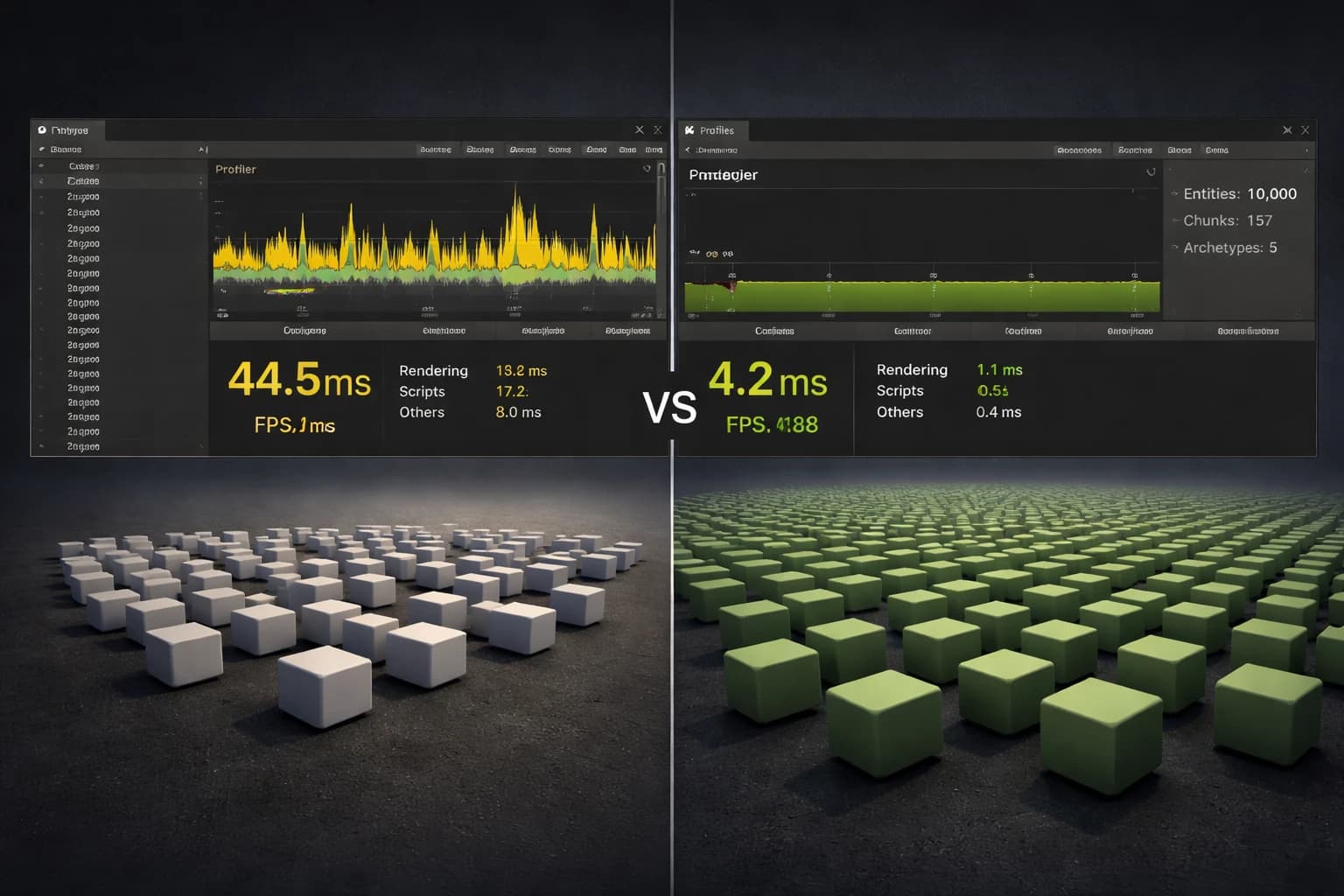 Unity DOTS performance comparison, https://darkounity.com/blog/getting-started-with-unity-6-dots-and-ecs-in-2026
Procedural generation is also not just about saving time and generating unique game designs; it also allows us to rethink the game development pipeline by designing video games using Data-Oriented Design (DOD). In Unity, this approach is also called DOTS (Data-Oriented Technology Stack), where it lays out game data so that the CPU can exploit cache locality and parallelism. This matters because game logic has traditionally been very hard to spread across multiple cores and not performant, so structuring around data that can be processed in parallel can give us great speedups.
In summary, procedural and parametric generation are powerful concepts in game development. Beyond saving time and costs, they encourage us to architect our video games around data, which allows us to utilize DOTS to process work in parallel rather than being bottlenecked on a single core.